
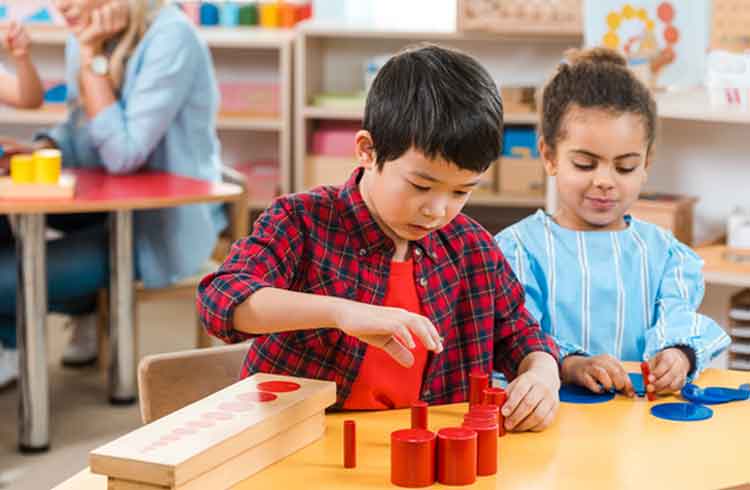
While Montessori materials are often seen as tools for academic learning, they are in fact meticulously designed to build a wide array of practical, real-world skills that are essential for life. The materials and the work associated with them go far beyond teaching letters and numbers; they are foundational exercises in problem-solving, concentration, independence, and fine motor control. This practical approach is what allows Montessori-educated children to transition into adulthood with a strong sense of purpose and the confidence to navigate the complexities of life.
The Practical Life materials, in particular, are a cornerstone of this skill-building. Activities like pouring water from a pitcher, buttoning frames, or sweeping the floor are not just about keeping the classroom tidy. They are exercises in coordination, concentration, and independence. When a child learns to tie their own shoes or prepare a snack for themselves, they are not just mastering a skill; they are building a sense of competence and self-worth. These activities teach a child that they are capable and that their contributions are valuable. This early experience with practical tasks lays the groundwork for a child to become a responsible and self-sufficient adult. It also refines their fine motor skills and hand-eye coordination, which are prerequisites for more academic work like writing and drawing.
Beyond Practical Life, the sensorial and academic materials also build essential life skills. The Sensorial materials, which are designed to refine a child’s five senses, are training their mind to be more observant and analytical. A child who learns to grade the color tablets from darkest to lightest is developing their visual discrimination. A child who works with the geometric solids is training their mind to understand spatial relationships and forms. This heightened awareness of their environment and the ability to notice subtle details is a skill that is valuable in every aspect of life, from science and art to everyday problem-solving. Similarly, the self-correcting nature of the materials teaches a child to view mistakes not as failures, but as opportunities for learning. When a child working with the Pink Tower realizes a block is out of place, they are learning to self-correct without external intervention. This builds resilience and a growth mindset, two traits that are crucial for success in any field. In essence, the Montessori materials provide a hands-on, tangible path to developing a child’s intellect, character, and practical abilities, ensuring they are well-prepared for the challenges and opportunities that lie ahead.