
Bringing the Philosophy Beyond the Classroom Walls
Montessori is more than just a method of education; it’s a philosophy for supporting human development. While the specific didactic materials are the domain of the classroom, the core principles that underpin the method are universally applicable and can be powerfully integrated into home life. Parents do not need to purchase expensive materials or replicate a classroom to bring the benefits of Montessori into their child’s daily experience. By focusing on a few key ideas, families can create a home environment that fosters independence, confidence, and a lifelong love of learning.
Prepare the Environment for Independence
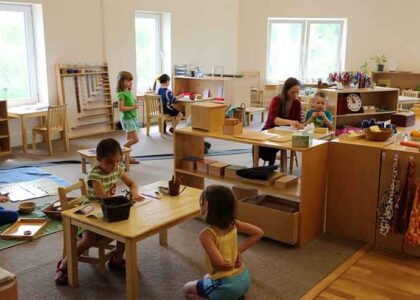
The guiding principle of a Montessori home is “Help me to do it myself.” This means preparing your home environment so that your child can be as independent as possible. Look at your home from your child’s perspective. Can they reach their own cup? Can they access a healthy snack? Can they hang up their own coat? Simple adjustments can make a world of difference. Consider a small, child-sized table and chair in the kitchen for meals and activities. Place a low stool in the bathroom so they can reach the sink to wash their hands. Use low, open shelves for toys and books so they can choose their own activities and, just as importantly, put them away. Creating this accessible environment sends a powerful message of trust and respect, telling your child, “You are a capable member of our family.”
Involve Children in Practical Life
In the classroom, “Practical Life” activities are the foundation of the curriculum. At home, real life provides endless opportunities for this work. Instead of trying to keep your child entertained while you do chores, invite them to participate. Toddlers can help put laundry into the machine, wipe up spills with a small sponge, or help set the table by carrying their own non-breakable plate and cutlery. Preschoolers can help with food preparation by washing vegetables, stirring ingredients, or using a child-safe knife to slice a banana. While it may be slower and messier at first, this involvement is incredibly valuable. It develops fine and gross motor skills, builds concentration, and gives the child a sense of significance and belonging within the family unit.
Respect the Child’s Concentration
One of Dr. Montessori’s most important discoveries was the power of concentration in a child’s development. When a child is deeply engaged in an activity—whether it’s stacking blocks, watching an ant crawl across the sidewalk, or trying to put on their own shoes—their mind is hard at work. As parents, our instinct is often to interrupt, to help, or to praise. A Montessori approach encourages us to step back and protect that concentration. Avoid the urge to say, “Good job!” while they are still working, as this can break their focus. Allow them to struggle with a task without immediately rushing in to fix it. This respectful observation allows the child to follow their own interests and develop the profound ability to focus, which is the bedrock of all future learning.
Offer Freedom Within Limits
Montessori is not a permissive, “do whatever you want” approach. It is about providing “freedom within limits.” The limits are the clear and consistent boundaries that keep the child safe and respected. The freedom is the choice they have within those boundaries. Instead of asking an open-ended question like, “What do you want to wear?” which can be overwhelming, offer a limited choice: “Would you like to wear the red shirt or the blue shirt?” This respects the child’s need for autonomy while maintaining a clear structure. The same principle applies to activities. Instead of a chaotic room full of toys, offer a curated selection of purposeful activities on a shelf. The child is free to choose any activity, but the limit is that they must put it away before choosing another. This framework helps children develop self-discipline and decision-making skills in a supportive and predictable environment.