
A Transformative Journey, Not Just a Certification
Pursuing a career in education is a significant commitment, and choosing the right path is crucial. For those drawn to child-centered learning, the question often arises: Is Montessori teacher training worth the investment of time, effort, and money? Unlike conventional teacher education programs, an accredited Montessori training course is an immersive and often intense experience. It goes far beyond lesson plans and classroom management techniques, demanding a profound personal and professional transformation. For those who complete it, the answer is overwhelmingly yes—it is a deeply rewarding journey that reshapes one’s entire understanding of education and child development.
A Deep Dive into Child Psychology
At the heart of any reputable Montessori training program (such as those accredited by AMI or AMS) is a comprehensive study of child development theory. Trainees delve into Dr. Montessori’s writings, exploring concepts like the Absorbent Mind, the Planes of Development, and the Sensitive Periods. This isn’t just academic theory; it’s a new lens through which to view the child. Instead of seeing a child who is “misbehaving,” a trained guide sees a child struggling to meet an unmet developmental need. This deep psychological understanding allows the teacher to prepare an environment and offer activities that perfectly match the child’s inner drive to learn. It shifts the role from a director of learning to a scientific observer and facilitator, enabling the teacher to support the child’s natural development with precision and respect. This profound shift in perspective is one of the most valuable takeaways from the training.
Mastery of the Didactic Materials
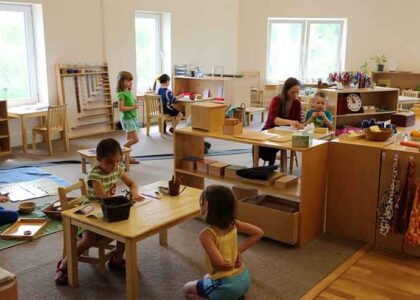
A significant portion of the training is dedicated to hands-on practice with the full range of Montessori materials. Trainees spend countless hours working with each piece of equipment, from the Practical Life exercises to the advanced math and language materials. They must practice the specific presentations until their movements are precise, efficient, and graceful. The purpose is twofold. First, it ensures they understand the direct and indirect aims of every material and can present it to a child in a clear, compelling way. Second, and perhaps more importantly, it allows the adult to experience the learning process themselves. By building the Pink Tower or working with the Binomial Cube, the adult trainee internalizes the concepts and comes to appreciate the genius of the material’s design. This personal experience creates a deep respect for the materials and the child’s work, which is essential for becoming an effective guide.
The Art of Scientific Observation
Montessori training fundamentally redefines the teacher’s role in the classroom. Central to this new role is the practice of scientific observation. Trainees are taught to observe children with purpose and precision, taking objective notes without judgment. They learn to see the classroom not as a place to dispense information, but as a laboratory for observing human development unfold. This practice is the guide’s most important tool. It informs every decision: when to present a new lesson, when to step back and allow a child to struggle, how to modify the environment to better meet the needs of the group, and how to identify and support a child’s emerging interests. This skill transforms the teacher from a reactive instructor into a proactive guide who can anticipate needs and prepare the conditions for optimal learning. It is a subtle but powerful art that separates a true Montessori guide from a traditional teacher.
A Rewarding and Respected Career Path
Beyond the personal transformation, Montessori training opens doors to a fulfilling and globally recognized career. The demand for well-trained, accredited Montessori guides is consistently high around the world. Graduates are equipped to lead their own classrooms, work as educational consultants, open their own schools, or become trainers for the next generation of teachers. The rigorous nature of the training is respected by schools and parents alike, signaling a deep commitment to authentic Montessori principles. For those passionate about making a genuine difference in the lives of children, the training provides the philosophy, the tools, and the community to build a lifelong career based on respect, empowerment, and a profound love for learning.